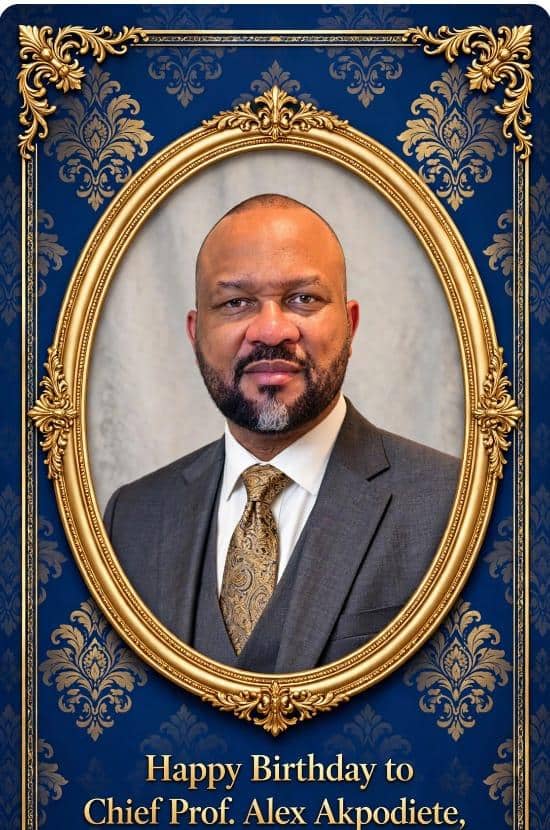
******My 31-Year-Old Legal Article Gains Renewed Attention in American Law-Akpodiete
******Akpodiete Enthusiastic Over His 1995 Law Article in American University Journal, Now Contributes to American Law Scholarly Discourse
****Nigerian Born Legal ICON commends Development, Says “Research Matters, Good Scholarship can Travel Farther, Last longer than its Author Anticipates”.
By Victor Bieni, Asaba
Professor Alex O. Akpodiete, Nigerian-American Scholar, Professor of Law, Forensic, Cyber Security and AI Governance, has said that his 31-Year-Old legal article has gained renewed attention in American Law as he expresses Joy over his 1995 article as a young lawyer that is currently contributing to American Law Scholarly Discourse.
Royal Paradise Media (News Online) learnt this from Prof Alex.O. Akpodiete in a telephone conversation with our reporter today being on Saturday, September 26, 2026 as he stated that he revisited the article recently which he authored as a young lawyer shortly after earning his Juris Doctor from the
University of Miami School of Law and commencing legal practice in the United States.
Speaking to our reporter, Professor Akpodiete stated that the article was titled: “Reconciling Plaintiff’s CHOICE to Sue in State Court With Defendant’s Desire to Defend in Federal Court,” was published in October 1995 by The Florida Bar Journal.
In the words of the Nigerian-American Scholar and Legal Luminary: “The publication examined a critical question in United States federal civil procedure concerning the circumstances under which a defendant may remove a case filed by a plaintiff in state court to federal court”.
“It provided a detailed analysis of federal-question and diversity jurisdiction, the well-pleaded complaint rule, the voluntary and involuntary rule, fraudulent joinder, remand and the competing procedural interests of plaintiffs and defendants”.
“The article further explored how American courts seek to balance a plaintiff’s initial choice of forum with a defendant’s statutory right of removal where federal jurisdiction exists”.
“What has now brought renewed interest is the discovery that the 1995 article has continued to contribute to scholarly discourse in American law many years after its publication”.
“In 2009, legal scholar Paul Rosenthal published an article titled “Improper Joinder: Confronting Plaintiffs’ Attempts to Destroy Federal Subject Matter Jurisdiction” in the American University Law Review, Volume 59″.
“Rosenthal’s article examined strategies employed to prevent removal to federal court and the doctrine traditionally referred to as fraudulent joinder, including the different standards applied by courts in determining whether a non-diverse defendant has been improperly joined”.
“In his analysis, Rosenthal advocated for a clearer and more uniform standard governing improper joinder and discussed what some courts and scholars have described as the absolute standard or no possibility approach to fraudulent joinder”.
“In that discussion, Rosenthal cited Prof. Akpodiete’s 1995 Florida Bar Journal article, thereby incorporating it into contemporary academic debate on federal jurisdiction”.
“My reactions on how my article is currently contributing to American Law scholarly discourse is in line with the above discovery. The citation is humbling and that shows scholarship has a remarkably long life. That is, work done as a young lawyer in 1995 has remained relevant in academic literature decades later”.
“My Professional focus has since expanded into academia, cyber security, digital forensics, artificial intelligence, AI governance and ethics and executive education”.
“But the experience serves as a reminder to students that research and writing matter and that good scholarship can travel farther and last longer than its author anticipates”, Professor of Law, Forensic, CyberSecurity, Artificial Intelligence, AI Governance, Ethics & Executive Education Concluded.